Wednesday, May 31, 2000
Entry doors have personalities ranging from friendly to frightened, cheap to opulent, artsy to severe. Today my job is to remove a pair of double doors that convey neglect and indifference. In their place I'll install windowed doors, warm and tasteful.
The building is a rather ordinary 1940's-era house that was converted to an office. It's located in downtown Menlo Park, just across the street from a popular gourmet grocery called Draeger's Market.
It's a sunny day, pleasant. People are strolling on the sidewalk carrying grocery bags with french bread and lacy green carrot tops sticking out.
Normally I would order pre-hung doors. Then I can simply pop out the old casing and pop in the new. With pre-hung double doors, I could avoid all the fussing and fitting required to line up two oversize, very heavy entry doors. This time, however, the building inspector warned that if I remove the old door casing, I will be "breaking the shell" of the exterior. Once broken, he can require that the entire old building be brought up to code including all the new handicap-access rules. The inspector almost drools, imagining all the violations he could cite.
So naturally - as instructed by the landlord - I'm not going to break the shell.
I'm in public view of the street, working alone though not unobserved. Sidewalk superintendents stop, watch, move on. Construction work is entertaining; it has a basic story arc: destructive beginning, hard-working middle, satisfying end. It's visual and easy to understand. You don't get that by watching somebody work at a desk.
I like to set a rhythm, working alone. There's an intensity, a kind of hypnosis of routing, chiseling, drilling, screwing, lifting.
As I begin painting the newly-installed door, I hear "Hooray!" accompanied by hands clapping. Four passers-by, standing on the sidewalk, are applauding!
Maybe it's the paint, a dramatic cobalt blue. Maybe it's the satisfaction of a familiar plot, freshly presented. Or maybe they simply hated those old weather-beaten doors.
Whatever the cause, they've broken my shell. I'll take it, the one and only time I've been applauded as a carpenter. Thank you, Menlo Park.

Tuesday, May 31, 2011

Monday, May 30, 2011
Memorial Day
Monday, May 30, 1983
On a weekend job in my truck, I drive north on Interstate 280. It's a jam of camper trucks, RV's, trailers towing dune buggies and motorboats.
 From the freeway there's a view of the valley of the San Francisco Bay, the airport, the ring of mountains. Just before passing through a riot of shopping centers, one can look down and see, among the rows of headstones, an old woman in her Sunday coat. She's on her knees in front of one particular grave.
We've lost them by the thousands. We grieve them one by one.
We remember people for who they were. Our frame of reference - inevitably, for better or worse - is who we were when we knew them.
Denny was a freckle-faced, jug-eared, left-handed kid in my high school in Maryland. Thin as a whip. He wasn't great at sports, but he was scrappy and he was fun. We played baseball, football. We weren't friends. I only knew him through sports and seeing him at school, where he hung with a different group.
Denny and I were practically the same age - just two days between us.
I never saw him after high school, so all I know is what I learn from The Wall. I went to college in Missouri. Denny moved to Colorado and, a couple years after high school, was drafted.
On May 2, 1968, I would have been preparing for junior year final exams. The musical Hair had just opened on Broadway. On May 2, Denny began his tour of duty with the 101st Airbourne. It didn't last long.
On August 5, 1968 I was camping in a pup tent on Bainbridge Island near Seattle, Washington, exploring the USA with my girlfriend in a Volkswagen beetle. Richard Nixon was being nominated at the Republican national convention in Miami. On August 5, in Thua Thien, South Vietnam, Denny was a "ground casualty, hostile," caused by "other explosive device." His body was recovered.
In a couple more weeks, Denny would have turned 21. A couple weeks later I drove through Chicago passing truckloads of National Guard troops, who were pouring into the city for the Democratic national convention. Near Rochester, New York I turned 21 and (legally) bought a bottle of champagne. The woman in the liquor store said, "Is that your driver's license?" She turned to another woman and pointed at me. "My, my, that little thing's twenty-one."
Different tours, different outcomes.
Two day's difference in birthdays, another lottery number in the draft, a different sense of obligation, it might have been me. I honor you, Denny, for the choices you made and the price that you paid. I remember you. Rest easy, forever.
On a weekend job in my truck, I drive north on Interstate 280. It's a jam of camper trucks, RV's, trailers towing dune buggies and motorboats.
 From the freeway there's a view of the valley of the San Francisco Bay, the airport, the ring of mountains. Just before passing through a riot of shopping centers, one can look down and see, among the rows of headstones, an old woman in her Sunday coat. She's on her knees in front of one particular grave.
 We've lost them by the thousands. We grieve them one by one.
We remember people for who they were. Our frame of reference - inevitably, for better or worse - is who we were when we knew them.
Denny was a freckle-faced, jug-eared, left-handed kid in my high school in Maryland. Thin as a whip. He wasn't great at sports, but he was scrappy and he was fun. We played baseball, football. We weren't friends. I only knew him through sports and seeing him at school, where he hung with a different group.
Denny and I were practically the same age - just two days between us.
I never saw him after high school, so all I know is what I learn from The Wall. I went to college in Missouri. Denny moved to Colorado and, a couple years after high school, was drafted.
On May 2, 1968, I would have been preparing for junior year final exams. The musical Hair had just opened on Broadway. On May 2, Denny began his tour of duty with the 101st Airbourne. It didn't last long.
On August 5, 1968 I was camping in a pup tent on Bainbridge Island near Seattle, Washington, exploring the USA with my girlfriend in a Volkswagen beetle. Richard Nixon was being nominated at the Republican national convention in Miami. On August 5, in Thua Thien, South Vietnam, Denny was a "ground casualty, hostile," caused by "other explosive device." His body was recovered.
In a couple more weeks, Denny would have turned 21. A couple weeks later I drove through Chicago passing truckloads of National Guard troops, who were pouring into the city for the Democratic national convention. Near Rochester, New York I turned 21 and (legally) bought a bottle of champagne. The woman in the liquor store said, "Is that your driver's license?" She turned to another woman and pointed at me. "My, my, that little thing's twenty-one."
Different tours, different outcomes.
Two day's difference in birthdays, another lottery number in the draft, a different sense of obligation, it might have been me. I honor you, Denny, for the choices you made and the price that you paid. I remember you. Rest easy, forever.
Saturday, May 28, 2011
Bombland (Dream Two)
Saturday, May 28, 1983
Sometimes the monsters aren't imaginary. Nineteen years before the mandap, on a Memorial Day weekend, this happened:
Sometimes the monsters aren't imaginary. Nineteen years before the mandap, on a Memorial Day weekend, this happened:
Bombland
She of four years, nine months,
wide eyes, fragile bones,
wakes screaming, runs through
the dark house. I catch her.
She says, "I can't stop thinking about bombs."
I hold her. Hot flesh. Rabbit pulse.
"I just couldn't stop thinking."
We share a lap, a cuddle, a cup
of hot chocolate. She says,
"They scare me.
You know where they come from?
They come from Bombland .
I hope they always stay there. I
hate the people who make bombs."
Friday, May 27, 2011
Spooked (Dream One)
Wednesday, May 27, 1981
Twenty-one years before the need for a mandap, my daughter awakes in the night screaming with terror. From a sound sleep I'm up and in her room. She's two and a half. She's clutching her special blanket.
"What is it?"
"An ookie spookie monster was coming in the window."
I check the window. Closed. Peering out, I say, "It's gone now."
I wait until she's calmed down, sleeping, then return to bed.
A half hour later she's screaming again. Before I can get up she runs to the bed and climbs in. "It came back," she says. "I heard it."
She stays until morning.
At breakfast I talk about how sometimes, especially at night, we think we see or hear things that are really only in our imaginations. Ideas get planted in our minds. Sometimes in the daytime we see something, and it stays in our mind, and then later at night we think about it. Did somebody read a story about monsters yesterday?
"But I heard it," my daughter says. "With my ears."
"It might've been branches. The wind can blow them and they scrape against the house."
"Ookie spookie branches."
I can't argue with that.
After dropping her at school, my morning job is to install a dryer outlet at a little bungalow in Redwood City. The owner left me a key and warned me: "I've got a restraining order against my husband. Do not let him in. He's trying to get the Bosendorfer."
"Uh... The what?"
"The piano. And you really don't want to know about all that."
It's a quiet morning in a quiet neighborhood. As I put the key in the lock, from inside the house I hear somebody playing a piano. An atonal scale. Modern junk. I open the door a crack. "Hello?" I call.
The piano stops. No answer.
I stick my head inside. The shades are drawn, but I can see the piano. Nobody there.
"Hello?" I call again.
The house is silent.
Okay I admit: I'm spooked.
There's a flash of motion, a gray blur over the rug.
It dashes between my feet: a kitten. And it's gone.
Twenty-one years before the need for a mandap, my daughter awakes in the night screaming with terror. From a sound sleep I'm up and in her room. She's two and a half. She's clutching her special blanket.
"What is it?"
"An ookie spookie monster was coming in the window."
I check the window. Closed. Peering out, I say, "It's gone now."
I wait until she's calmed down, sleeping, then return to bed.
A half hour later she's screaming again. Before I can get up she runs to the bed and climbs in. "It came back," she says. "I heard it."
She stays until morning.
At breakfast I talk about how sometimes, especially at night, we think we see or hear things that are really only in our imaginations. Ideas get planted in our minds. Sometimes in the daytime we see something, and it stays in our mind, and then later at night we think about it. Did somebody read a story about monsters yesterday?
"But I heard it," my daughter says. "With my ears."
"It might've been branches. The wind can blow them and they scrape against the house."
"Ookie spookie branches."
I can't argue with that.
After dropping her at school, my morning job is to install a dryer outlet at a little bungalow in Redwood City. The owner left me a key and warned me: "I've got a restraining order against my husband. Do not let him in. He's trying to get the Bosendorfer."
"Uh... The what?"
"The piano. And you really don't want to know about all that."
It's a quiet morning in a quiet neighborhood. As I put the key in the lock, from inside the house I hear somebody playing a piano. An atonal scale. Modern junk. I open the door a crack. "Hello?" I call.
The piano stops. No answer.
I stick my head inside. The shades are drawn, but I can see the piano. Nobody there.
"Hello?" I call again.
The house is silent.
Okay I admit: I'm spooked.
There's a flash of motion, a gray blur over the rug.
It dashes between my feet: a kitten. And it's gone.
Thursday, May 26, 2011
The Mandap (Part Two)
Sunday, May 26, 2002
 A wedding is a construction project. Sunday morning we make a convoy of pickups and cars. At the wedding site, like a crew of rock and roll roadies we erect the mandap and finish decorating it with flowers and paper wrapping. Helped by our friends, we string lights on the railing, place candles and vases, and wire speakers into the sound system. We are at Harbor House, a hall with a deck which overlooks Princeton Harbor and the famous Maverick's surf break.
Back home, we dress. Tux for me, suits for my sons.
And here we go. Returning to Harbor House, there is fog with occasional mist - Pacific coast weather. The mandap is put to immediate use: first thing, everybody writes a message on a yellow ribbon and tacks it among the flowers and ivy. Mine, “Be fruitful and multiply!” Not that I'm pressuring them or anything...
Hors d’oeuvres are artfully presented on the deck, but I’m too excited to eat. At 4:30 the groom arrives astride his steed - the white Mustang convertible - music blaring, aunties dancing, guests blowing bubbles. Before the bride can greet the groom, the aunties and mother-of-the-groom wrap her in a shawl, pinned just so. And bury her in jewelry.
Krishna, who is a pharmacy student, serves as punditji and conducts the ceremony in the mandap. There are rituals to perform, all a mystery to me. My wife and I, sitting in chairs, notice the ugly green wine glass that was intended to be stomped - that we have hated for years - on the altar, filled with rice. Now it can't be stomped; it's a sacred vessel. I turn to Mark, knowing he’ll understand because he's Jewish, and say, “Quick, find a light bulb and wrap it in a napkin.” He returns and says, “Don’t look in the bathroom.”
Fishing boats chug in and out of the harbor, passing our little ceremony. Rock music from a bar band floats over the water.
If you grow up in a Christian house and later find yourself playing a major role in a Hindu wedding, just do what you're told. Sip water when instructed, toss petals, sprinkle rice, chant prayers. At one point, unexpected by me, I am asked to put some folding money out as a donation. This rented tuxedo has endless secret pockets. Which one has my wallet? As I fumble, I'm thinking that I brought a wad of hundred-dollar bills to pay the catering crew in cash, something they greatly appreciate. Do I have small bills? The folding money that I donate at this moment will later be tossed into the ocean as some sort of offering. Will I have to toss hundred-dollar bills into the ocean?
Still fumbling for my wallet, I mutter “I hope I have some,” and then to the punditji I say “Do you take credit cards?” which gets a good laugh from the audience. At last I find the wallet - and some dollar bills. Whew.
I smudge a red spot on the bride and groom’s foreheads.
Suddenly in the middle of the ceremony the aunties in their colorful saris interrupt, crying "No no no!" Shouting in Punjabi dialect, they climb over chairs and swarm into the mandap rearranging icons and instructing the pharmacy student/punditji on what should happen next. The bride and groom have tried to streamline the ceremony, which in a true Indian wedding can go on for hours, but the aunties aren't buying it. After some negotiation, all handled in dialect I can't understand, a few more rituals are added. The aunties, satisfied, take their seats. Imagine this scene at Christian nuptials. My friends are all smiles. This is the most entertaining wedding they've ever attended.
Of course what I'm thinking is: what do the aunties have to say about the mandap? Does it meet their strict standards? Will they berate me after the ceremony? They seem like warm and wonderful people, great dancers, but now they scare the crap out of me.
The punditji tells me to toss petals at the couple: “Big toss. Lots of bless.” The bride and groom stand and read a variant of traditional American vows. No “obey” and no “I do.” But recognizable. Then after several stomps (it’s a small bulb), the groom breaks the glass.

Hours later after dinner and toasts and more dancing, it’s over. The bride and groom depart in their white Mustang for their hotel and, tomorrow, a flight to Paris with certified passports in hand. We disassemble the mandap. Flowers and ivy are still fresh, seemingly nourished by the misty breeze. The structure held.
Next morning, returning for a final garbage pickup, I install a new light bulb in the bathroom.
Later, we gather with the guests for a final goodbye. One by one, the aunties take me aside. Each says the same thing: "It was a beautiful mandap. The best."
(The story continues here, eleven years later.)
 A wedding is a construction project. Sunday morning we make a convoy of pickups and cars. At the wedding site, like a crew of rock and roll roadies we erect the mandap and finish decorating it with flowers and paper wrapping. Helped by our friends, we string lights on the railing, place candles and vases, and wire speakers into the sound system. We are at Harbor House, a hall with a deck which overlooks Princeton Harbor and the famous Maverick's surf break.
 Back home, we dress. Tux for me, suits for my sons.
And here we go. Returning to Harbor House, there is fog with occasional mist - Pacific coast weather. The mandap is put to immediate use: first thing, everybody writes a message on a yellow ribbon and tacks it among the flowers and ivy. Mine, “Be fruitful and multiply!” Not that I'm pressuring them or anything...
Hors d’oeuvres are artfully presented on the deck, but I’m too excited to eat. At 4:30 the groom arrives astride his steed - the white Mustang convertible - music blaring, aunties dancing, guests blowing bubbles. Before the bride can greet the groom, the aunties and mother-of-the-groom wrap her in a shawl, pinned just so. And bury her in jewelry.

Krishna, who is a pharmacy student, serves as punditji and conducts the ceremony in the mandap. There are rituals to perform, all a mystery to me. My wife and I, sitting in chairs, notice the ugly green wine glass that was intended to be stomped - that we have hated for years - on the altar, filled with rice. Now it can't be stomped; it's a sacred vessel. I turn to Mark, knowing he’ll understand because he's Jewish, and say, “Quick, find a light bulb and wrap it in a napkin.” He returns and says, “Don’t look in the bathroom.”
Fishing boats chug in and out of the harbor, passing our little ceremony. Rock music from a bar band floats over the water.
If you grow up in a Christian house and later find yourself playing a major role in a Hindu wedding, just do what you're told. Sip water when instructed, toss petals, sprinkle rice, chant prayers. At one point, unexpected by me, I am asked to put some folding money out as a donation. This rented tuxedo has endless secret pockets. Which one has my wallet? As I fumble, I'm thinking that I brought a wad of hundred-dollar bills to pay the catering crew in cash, something they greatly appreciate. Do I have small bills? The folding money that I donate at this moment will later be tossed into the ocean as some sort of offering. Will I have to toss hundred-dollar bills into the ocean?
Still fumbling for my wallet, I mutter “I hope I have some,” and then to the punditji I say “Do you take credit cards?” which gets a good laugh from the audience. At last I find the wallet - and some dollar bills. Whew.
I smudge a red spot on the bride and groom’s foreheads.
Suddenly in the middle of the ceremony the aunties in their colorful saris interrupt, crying "No no no!" Shouting in Punjabi dialect, they climb over chairs and swarm into the mandap rearranging icons and instructing the pharmacy student/punditji on what should happen next. The bride and groom have tried to streamline the ceremony, which in a true Indian wedding can go on for hours, but the aunties aren't buying it. After some negotiation, all handled in dialect I can't understand, a few more rituals are added. The aunties, satisfied, take their seats. Imagine this scene at Christian nuptials. My friends are all smiles. This is the most entertaining wedding they've ever attended.
Of course what I'm thinking is: what do the aunties have to say about the mandap? Does it meet their strict standards? Will they berate me after the ceremony? They seem like warm and wonderful people, great dancers, but now they scare the crap out of me.

The punditji tells me to toss petals at the couple: “Big toss. Lots of bless.” The bride and groom stand and read a variant of traditional American vows. No “obey” and no “I do.” But recognizable. Then after several stomps (it’s a small bulb), the groom breaks the glass.

Hours later after dinner and toasts and more dancing, it’s over. The bride and groom depart in their white Mustang for their hotel and, tomorrow, a flight to Paris with certified passports in hand. We disassemble the mandap. Flowers and ivy are still fresh, seemingly nourished by the misty breeze. The structure held.
Next morning, returning for a final garbage pickup, I install a new light bulb in the bathroom.
Later, we gather with the guests for a final goodbye. One by one, the aunties take me aside. Each says the same thing: "It was a beautiful mandap. The best."
(The story continues here, eleven years later.)
Wednesday, May 25, 2011
The Mandap (Part One)
Saturday, May 25, 2002
For the first 54 years of my life, I've never even heard of a mandap. Now I'm supposed to build one for my daughter's wedding. (It's pronounced "mun-dup," by the way.)
I call the father of the groom. A lovely man. He has a soft voice, an Indian accent. We are at the mercy of crappy cell phone technology long distance to Minnesota. I think he says that a metal structure is preferred but that I can substitute wood if I must. I also think he says that wood is considered ugly in Indian culture, so every inch of the mandap should be covered with flowers. (None of this is true, but that's what I think I hear at the time.)
Then I watch Monsoon Wedding with Aunt Lila. Half way through the movie, Lila elbows me and whispers, "You're in deep trouble." The Indian wedding depicted in that film would require years of preparation.
For our situation, the design for the mandap has to allow pre-cut and pre-drilled pieces to be quickly assembled on the morning of the wedding, then easily disassembled after the ceremony in a facility we are renting for one day only. Further, the mandap should be light-weight but sturdy enough to stand 8 feet tall with a 12 foot span supporting a heavy load of flowers.
I come up with a plan of 2x2 posts, one at each corner, supporting a top frame of doubled 1x3's, one on each side of the post with short pieces of 2x2 blocking along the middle. I'm a little nervous about that 12 foot span of doubled 1x3's. I wouldn't want some impetuous teenager to try to do chin-ups. For flowers, though, it should hold.
I buy clear heart redwood for the posts, clear select redwood for the beams. I stain it with a wash of white, rendering it light in color with the grain still visible.
Meanwhile, since a wedding party will be held at our home, I have a self-imposed deadline to finish the construction of a house I began building in 1979. What remains is what we call "the powder room," which is simply a half-bath (why do people call a room with neither shower nor bath a half-bath?). With help from my son - plus heavy doses of ibuprofen for my back - I finish the job two days before the wedding. It's taken 23 years, a major earthquake, a furnace fire, a termite infestation, several falling trees, the damage of 3 dogs, the life cycle of 3 pickup trucks, the raising of 3 children, and now a wedding to complete this house. But it's done, with a mandap for a bonus.
Flowers must be cheaper in India. There is no way we can afford to cover this mandap with blossoms. We do buy a truckload of color for the ceremony and the mandap combined. What we also have - in wretched excess - is English ivy, an invasive species that has overwhelmed our redwood forest and our own yard in particular. The deep green leaves of ivy will look wonderful when twined among the flowers. Our friends Heidi and Richard gather ivy from the yard and wrap experimental arrangements around the 1x3's, weaving blossoms.

Other dramas unfold. Indian custom has the groom arriving at the wedding astride a white horse. Many phone calls fail to overcome problems of logistics and insurance and such simple questions as who will clean up the rented facility after the horse is gone? Finally I have a suggestion: could the groom arrive in a white Mustang convertible? Everyone embraces the idea. The white Mustang is rented.
Another last-minute drama involves an expired passport, frantic phone calls, copious amounts of money, the wrong shipping label on a FedEx overnight, the package lost in Memphis, more phone calls - and hours before the wedding, the passport is delivered. Whew.
Now I have a truckload of partly flower-and-ivy bedecked lumber, each a separate piece, ready to assemble tomorrow. Tonight is the mehndi party.
A wedding is the joining of two families. In this case, it is the joining of two cultures as well. Tonight is Punjabi culture. We are guests of the groom's family, entering a different world. An Indian mehndi party involves gifts of jewelry, henna designs painted on hands.

The groom's entire extended family is here. The aunties are high-spirited live wires. There is Indian music, exuberant dancing - again, the aunties are wild - singing, food, drink, joy. These folk know how to celebrate a marriage.
My only worry: will the mandap, the focal point of tomorrow's ceremony, be acceptable? Will it even stand?
(The story continues here.)
(And then there's a postscript here.)
For the first 54 years of my life, I've never even heard of a mandap. Now I'm supposed to build one for my daughter's wedding. (It's pronounced "mun-dup," by the way.)
I call the father of the groom. A lovely man. He has a soft voice, an Indian accent. We are at the mercy of crappy cell phone technology long distance to Minnesota. I think he says that a metal structure is preferred but that I can substitute wood if I must. I also think he says that wood is considered ugly in Indian culture, so every inch of the mandap should be covered with flowers. (None of this is true, but that's what I think I hear at the time.)
Then I watch Monsoon Wedding with Aunt Lila. Half way through the movie, Lila elbows me and whispers, "You're in deep trouble." The Indian wedding depicted in that film would require years of preparation.
For our situation, the design for the mandap has to allow pre-cut and pre-drilled pieces to be quickly assembled on the morning of the wedding, then easily disassembled after the ceremony in a facility we are renting for one day only. Further, the mandap should be light-weight but sturdy enough to stand 8 feet tall with a 12 foot span supporting a heavy load of flowers.
I come up with a plan of 2x2 posts, one at each corner, supporting a top frame of doubled 1x3's, one on each side of the post with short pieces of 2x2 blocking along the middle. I'm a little nervous about that 12 foot span of doubled 1x3's. I wouldn't want some impetuous teenager to try to do chin-ups. For flowers, though, it should hold.
 | |
| Napkin sketch of the mandap design |
I buy clear heart redwood for the posts, clear select redwood for the beams. I stain it with a wash of white, rendering it light in color with the grain still visible.
Meanwhile, since a wedding party will be held at our home, I have a self-imposed deadline to finish the construction of a house I began building in 1979. What remains is what we call "the powder room," which is simply a half-bath (why do people call a room with neither shower nor bath a half-bath?). With help from my son - plus heavy doses of ibuprofen for my back - I finish the job two days before the wedding. It's taken 23 years, a major earthquake, a furnace fire, a termite infestation, several falling trees, the damage of 3 dogs, the life cycle of 3 pickup trucks, the raising of 3 children, and now a wedding to complete this house. But it's done, with a mandap for a bonus.
Flowers must be cheaper in India. There is no way we can afford to cover this mandap with blossoms. We do buy a truckload of color for the ceremony and the mandap combined. What we also have - in wretched excess - is English ivy, an invasive species that has overwhelmed our redwood forest and our own yard in particular. The deep green leaves of ivy will look wonderful when twined among the flowers. Our friends Heidi and Richard gather ivy from the yard and wrap experimental arrangements around the 1x3's, weaving blossoms.

Other dramas unfold. Indian custom has the groom arriving at the wedding astride a white horse. Many phone calls fail to overcome problems of logistics and insurance and such simple questions as who will clean up the rented facility after the horse is gone? Finally I have a suggestion: could the groom arrive in a white Mustang convertible? Everyone embraces the idea. The white Mustang is rented.
Another last-minute drama involves an expired passport, frantic phone calls, copious amounts of money, the wrong shipping label on a FedEx overnight, the package lost in Memphis, more phone calls - and hours before the wedding, the passport is delivered. Whew.
Now I have a truckload of partly flower-and-ivy bedecked lumber, each a separate piece, ready to assemble tomorrow. Tonight is the mehndi party.
A wedding is the joining of two families. In this case, it is the joining of two cultures as well. Tonight is Punjabi culture. We are guests of the groom's family, entering a different world. An Indian mehndi party involves gifts of jewelry, henna designs painted on hands.

The groom's entire extended family is here. The aunties are high-spirited live wires. There is Indian music, exuberant dancing - again, the aunties are wild - singing, food, drink, joy. These folk know how to celebrate a marriage.
My only worry: will the mandap, the focal point of tomorrow's ceremony, be acceptable? Will it even stand?
(The story continues here.)
(And then there's a postscript here.)
Tuesday, May 24, 2011
Bad Toilet
Tuesday, May 24, 1977
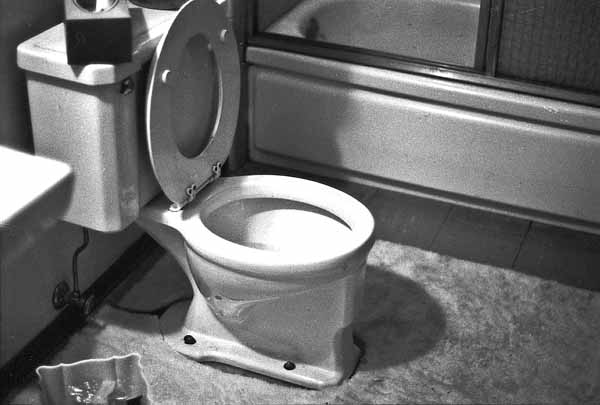
Have you ever been furious at a toilet? Has it ever become personal? Have you ever shouted "FLUSH EVERYTHING AT ONCE!" to a contemptuous ceramic crapper? Have you ever completely disassembled and reassembled a commode, replacing every replaceable part, and the damn thing STILL LEAKS?
The particular loo that inspired my poem turned out to have an invisible hairline crack.
Meanwhile, my dog Quinn used to have a fascination with those same devices:

One day, alas, Quinn investigated too deeply. From the other room I heard a splash, a flush, a hollow bubbling sound - then silence. No one ever saw that dog again.

Just kidding...
Have you ever been furious at a toilet? Has it ever become personal? Have you ever shouted "FLUSH EVERYTHING AT ONCE!" to a contemptuous ceramic crapper? Have you ever completely disassembled and reassembled a commode, replacing every replaceable part, and the damn thing STILL LEAKS?
The EnemyOr as one of my ex-pat British clients said to me, "This loo ain't worth a shit."
I have fixed water closets
for six years
but this particular piece of china
simply squatted there,
insolent white porcelain
leering
leaking
mocking my deadlines
flushing with a hiss and gurgle
that I swear was saying
Piss on you, Plumber.
The particular loo that inspired my poem turned out to have an invisible hairline crack.
Meanwhile, my dog Quinn used to have a fascination with those same devices:


One day, alas, Quinn investigated too deeply. From the other room I heard a splash, a flush, a hollow bubbling sound - then silence. No one ever saw that dog again.
Just kidding...
Wednesday, May 18, 2011
Shooting the Dog
Friday, May 18, 2001
A long time ago before a tree fell on his house, my neighbor George had a wonderful Australian shepherd dog. She was unspayed. George grew up on a farm in Illinois.
One day George came to my front door, obviously upset, and said incoherently: "Do you have a rifle you might shot my dog I gotta do something."
"George," I said, "I would never shoot your dog. And yes, I have a rifle."
As it turned out, he wasn't accusing me. He wanted to borrow my rifle so he could shoot his neighbor's dog, Gandalf.
Gandalf was an aggressive free-roaming black lab who was the bad boy of La Honda. I would have shot him myself after he latched onto my old German shepherd with teeth like a Vise Grip. Without time to fetch the rifle, though, I'd grabbed a handy two-by-four and whacked at Gandalf until he let go. I hit him so hard, the two-by-four broke in half. If it hadn't been such a low-grade piece of lumber, I would have killed him. After that incident, Gandalf stayed away from my house.
Today, though, Gandalf had torn a hole in a vent screen at George's house and somehow wriggled through the 6" by 12" opening, depositing red blood and black fur on the wires. Once inside, he had performed intimate activities with George's Australian shepherd, who was in heat and therefore confined to quarters. Now Gandalf was trapped in George's house, less eager to exit through that barbed opening than he had been to enter.
"It'll take me a minute to get the rifle," I said.
"I'll wait," George said.
At the time, I stored the gun in the attic and the ammo in the basement - separate - where my kids wouldn't find them. (And isn't it odd that I, the crunchy granola type, kept a rifle while George, the farm boy, did not? A story for another day.) By the time I brought the rifle outside to George, he'd changed his mind. "You really can't stop Mother Nature," he said. "Can I give you a puppy?"
"Not a half-Gandalf," I said.
So anyway, I'd forgotten about this incident and twenty years had passed. Then I got a call from Isabella about another house needing upscale lighting. By this time Isabella was popular and as a result I was crawling attics of the nouveau riche all over the Silicon Valley.
Isabella brought me to the home of Helena, a buxom blond woman. The house was a three-ring circus. In one ring, a couple of carpenters were replacing aluminum windows with wooden-sash models. Helena would pass by, tell the carpenters that two side-by-side windows were slightly out of alignment, and move on. The carpenters would spend 15 minutes removing and re-installing one of the frames, and then Helena would happen by and claim one corner was higher than the other. The carpenters with spirit levels would show that it was not.
Meanwhile a young teenage girl entered the home followed by five teenage boys, all of whom seemed older than the girl. They went to the kitchen where lemonade and peanut butter were put into play along with a radio and loud conversation. The girl seemed smiley but somewhat overwhelmed.
And in the third ring, Helena, Isabella and I discussed options for lighting.
Eventually we had a plan. Helena told the carpenters that their window was utterly unsatisfactory, then marched to the kitchen and ordered all the young men to leave. Respectfully, they departed. Angrily, the daughter said, "You're such a tight-ass." Then she ran upstairs.
Helena sighed. To Isabella she said, "She's fourteen and she's built like Barbie. I want her to handle it better than I did at that age. But I can't tell her a thing."
That's what made me think of Gandalf. "You can't stop Mother Nature," I said.
Helena looked at me like I was some random creep.
Maybe what I should have said was: Confinement won't work. Black wizards are out there.
Though I'd invested a couple hours in the estimate, I turned down the job. Helena wouldn't be any more happy with my lights than she was with the carpenters' windows.
At least I could walk away from it. Unlike the daughter.
Isabella to my surprise didn't try to change my mind. "It's true," Isabella said. "She's a tight-ass." And I was thinking: Later, Helena, you'll be asking to borrow my rifle.
A long time ago before a tree fell on his house, my neighbor George had a wonderful Australian shepherd dog. She was unspayed. George grew up on a farm in Illinois.
One day George came to my front door, obviously upset, and said incoherently: "Do you have a rifle you might shot my dog I gotta do something."
"George," I said, "I would never shoot your dog. And yes, I have a rifle."
As it turned out, he wasn't accusing me. He wanted to borrow my rifle so he could shoot his neighbor's dog, Gandalf.
Gandalf was an aggressive free-roaming black lab who was the bad boy of La Honda. I would have shot him myself after he latched onto my old German shepherd with teeth like a Vise Grip. Without time to fetch the rifle, though, I'd grabbed a handy two-by-four and whacked at Gandalf until he let go. I hit him so hard, the two-by-four broke in half. If it hadn't been such a low-grade piece of lumber, I would have killed him. After that incident, Gandalf stayed away from my house.
Today, though, Gandalf had torn a hole in a vent screen at George's house and somehow wriggled through the 6" by 12" opening, depositing red blood and black fur on the wires. Once inside, he had performed intimate activities with George's Australian shepherd, who was in heat and therefore confined to quarters. Now Gandalf was trapped in George's house, less eager to exit through that barbed opening than he had been to enter.
"It'll take me a minute to get the rifle," I said.
"I'll wait," George said.
At the time, I stored the gun in the attic and the ammo in the basement - separate - where my kids wouldn't find them. (And isn't it odd that I, the crunchy granola type, kept a rifle while George, the farm boy, did not? A story for another day.) By the time I brought the rifle outside to George, he'd changed his mind. "You really can't stop Mother Nature," he said. "Can I give you a puppy?"
"Not a half-Gandalf," I said.
So anyway, I'd forgotten about this incident and twenty years had passed. Then I got a call from Isabella about another house needing upscale lighting. By this time Isabella was popular and as a result I was crawling attics of the nouveau riche all over the Silicon Valley.
Isabella brought me to the home of Helena, a buxom blond woman. The house was a three-ring circus. In one ring, a couple of carpenters were replacing aluminum windows with wooden-sash models. Helena would pass by, tell the carpenters that two side-by-side windows were slightly out of alignment, and move on. The carpenters would spend 15 minutes removing and re-installing one of the frames, and then Helena would happen by and claim one corner was higher than the other. The carpenters with spirit levels would show that it was not.
Meanwhile a young teenage girl entered the home followed by five teenage boys, all of whom seemed older than the girl. They went to the kitchen where lemonade and peanut butter were put into play along with a radio and loud conversation. The girl seemed smiley but somewhat overwhelmed.
And in the third ring, Helena, Isabella and I discussed options for lighting.
Eventually we had a plan. Helena told the carpenters that their window was utterly unsatisfactory, then marched to the kitchen and ordered all the young men to leave. Respectfully, they departed. Angrily, the daughter said, "You're such a tight-ass." Then she ran upstairs.
Helena sighed. To Isabella she said, "She's fourteen and she's built like Barbie. I want her to handle it better than I did at that age. But I can't tell her a thing."
That's what made me think of Gandalf. "You can't stop Mother Nature," I said.
Helena looked at me like I was some random creep.
Maybe what I should have said was: Confinement won't work. Black wizards are out there.
Though I'd invested a couple hours in the estimate, I turned down the job. Helena wouldn't be any more happy with my lights than she was with the carpenters' windows.
At least I could walk away from it. Unlike the daughter.
Isabella to my surprise didn't try to change my mind. "It's true," Isabella said. "She's a tight-ass." And I was thinking: Later, Helena, you'll be asking to borrow my rifle.
Sunday, May 15, 2011
The Old Red Raleigh
Tuesday, May 15, 1982
In cleaning out the garage one Sunday afternoon I come upon my red Raleigh bicycle, a three-speed with coaster brakes. Now the gears are frozen, brakes locked, tires flat. Spokes have popped. Shoots of grass sprout from the leather seat. When I bought that bike, Eisenhower was president.
In my unsentimental out-with-the-crap mood, I toss the bike on top of the pile of garbage - old sinks, a warped door, shredded screens - in the back of my truck. Which is where my son finds it.
Jesse is all of five years old. His eyes are wide: "What's that?"
"My old bike. From when I was a kid. Tomorrow it's going to the dump."
"You're throwing it away?"
"It's a wreck, Jesse." Frame rusty, pedals stuck. Like my body.
"Aren't you going to fix it?"
"It's too old."
"If I fix it, can I have it?"
 From birth my son has grown up watching me fix things. He simply believes I can repair anything - or at least that I'll make an attempt. Now he wants to try.
"Jesse, this bike would be too big for you even if you could fix it. I got it when I was twelve years old. It'll be seven years before you could reach the pedals."
"I'll let you use it. Until I can."
"I think it's beyond help."
He scrapes at it with a screwdriver, bangs it with a wrench, rubs it with an oily rag. He has no effect. The pedals are frozen in place. With no idea what to do, he pounds on random parts, squirts random WD-40 or sits, chin on fist, studying.
I do yard chores. Jesse works on the bike. For three hours.
Three hours! This is a child in kindergarten.
At supper it's all he can talk about. My wife and I try to guide him down, lower his expectations. We talk about the value of experience even when you don't succeed. He won't listen. My wife asks me, "Do you have to dump it tomorrow?"
"I'll leave it here."
The next day, Monday, there's little time after school. Jesse flails at the bike. More oil. More banging. I'm too busy to see exactly what he's doing.
Tuesday there's more time after school. I go out to the driveway and help. Or at least ease the pain of failure. Oil has been wicking, penetrating for two days.
He's standing on a pedal with both feet, jumping up and down.
"What are you doing?"
"If I can loosen this pedal, maybe the wheels will move."
"It's not the pedal. It's the axle bearings."
"If I could just move this pedal." Now he bangs on it with a hammer.
I'm fond of this old machine. From age twelve I rode it in an expanding circle over the streets of suburban Maryland to the baseball diamond, and later the movie theater, and later to the house of a girl. Eventually I rode it on some mean streets in Philadelphia and then - strapped to the back of a Volkswagen - the Raleigh moved across a continent. For three years I rode it to my job on the graveyard shift, a midnight ride covering ten miles. I'd operate a computer through the night, then pedal home another ten miles at dawn. I was riding an anachronism, a three-speed with coaster brakes in a land of ten-speeds with hand brakes. And I had married that girl.
To Jesse I say, "You need some Liquid Wrench."
I squirt it into crannies and orifices.
Bracing my feet on the frame and my back against the garage, getting a good grip on the wheel I pull with all my might.
"Help me, Jesse."
He puts his weight into it, all forty pounds.
It moves! Was it the wheel that groaned, or was it my spine?
More oil. A loosening and tightening of bolts. A flooding sensation of relief, of peace: I fix things. We fix things, my son and I. We'll have to buy a new front wheel. A new tire for the rear. Probably have to replace that old Sturmey-Archer three speed shifting lever - do they still make them? No matter, we'll find a way. Bless the children for their foolish hope.
"You got yourself a bike, son."
In cleaning out the garage one Sunday afternoon I come upon my red Raleigh bicycle, a three-speed with coaster brakes. Now the gears are frozen, brakes locked, tires flat. Spokes have popped. Shoots of grass sprout from the leather seat. When I bought that bike, Eisenhower was president.
In my unsentimental out-with-the-crap mood, I toss the bike on top of the pile of garbage - old sinks, a warped door, shredded screens - in the back of my truck. Which is where my son finds it.
Jesse is all of five years old. His eyes are wide: "What's that?"
"My old bike. From when I was a kid. Tomorrow it's going to the dump."
"You're throwing it away?"
"It's a wreck, Jesse." Frame rusty, pedals stuck. Like my body.
"Aren't you going to fix it?"
"It's too old."
"If I fix it, can I have it?"
 From birth my son has grown up watching me fix things. He simply believes I can repair anything - or at least that I'll make an attempt. Now he wants to try.
 "Jesse, this bike would be too big for you even if you could fix it. I got it when I was twelve years old. It'll be seven years before you could reach the pedals."
"I'll let you use it. Until I can."
"I think it's beyond help."
He scrapes at it with a screwdriver, bangs it with a wrench, rubs it with an oily rag. He has no effect. The pedals are frozen in place. With no idea what to do, he pounds on random parts, squirts random WD-40 or sits, chin on fist, studying.
I do yard chores. Jesse works on the bike. For three hours.
Three hours! This is a child in kindergarten.
At supper it's all he can talk about. My wife and I try to guide him down, lower his expectations. We talk about the value of experience even when you don't succeed. He won't listen. My wife asks me, "Do you have to dump it tomorrow?"
"I'll leave it here."
The next day, Monday, there's little time after school. Jesse flails at the bike. More oil. More banging. I'm too busy to see exactly what he's doing.
Tuesday there's more time after school. I go out to the driveway and help. Or at least ease the pain of failure. Oil has been wicking, penetrating for two days.
He's standing on a pedal with both feet, jumping up and down.
"What are you doing?"
"If I can loosen this pedal, maybe the wheels will move."
"It's not the pedal. It's the axle bearings."
"If I could just move this pedal." Now he bangs on it with a hammer.
I'm fond of this old machine. From age twelve I rode it in an expanding circle over the streets of suburban Maryland to the baseball diamond, and later the movie theater, and later to the house of a girl. Eventually I rode it on some mean streets in Philadelphia and then - strapped to the back of a Volkswagen - the Raleigh moved across a continent. For three years I rode it to my job on the graveyard shift, a midnight ride covering ten miles. I'd operate a computer through the night, then pedal home another ten miles at dawn. I was riding an anachronism, a three-speed with coaster brakes in a land of ten-speeds with hand brakes. And I had married that girl.
To Jesse I say, "You need some Liquid Wrench."
I squirt it into crannies and orifices.
Bracing my feet on the frame and my back against the garage, getting a good grip on the wheel I pull with all my might.
"Help me, Jesse."
He puts his weight into it, all forty pounds.
It moves! Was it the wheel that groaned, or was it my spine?
More oil. A loosening and tightening of bolts. A flooding sensation of relief, of peace: I fix things. We fix things, my son and I. We'll have to buy a new front wheel. A new tire for the rear. Probably have to replace that old Sturmey-Archer three speed shifting lever - do they still make them? No matter, we'll find a way. Bless the children for their foolish hope.
"You got yourself a bike, son."
Saturday, May 14, 2011
Boy Scout Pocketknife
Saturday, May 14, 1983
In the garage I open a drawer and am face to face with a mama rat, three babes at her teats.
For one moment we gape.
Her instincts are faster. She leaps to the floor with a flop, babes clinging, dragging. She’s gone.
In seconds I destroy her home.
Beneath the nest, soaked in life’s liquids, lies my old pocketknife, Official Boy Scout model, now rusted, stinking, filthy. Wrecked.
 With this knife I whittled wood, punched leather, opened cans, played mumbledepeg, sliced legs off frogs. (Sorry.) More recently it's fallen into abuse: cutting insulation batts, trimming asphalt shingles, or just poking wood in search of termites.
My son Jesse wants it. First grade.
I say, “It’s ruined.”
Jesse says, “I’ll fix it.”
“What will you do with it?”
“Cut things.”
He’s six. Too young. “You have scissors to cut.”
“I want it.”
In six years I’ve learned to recognize need. What is it with boys and knives? I bought this - drained my life savings - in 1955. I wanted it. My parents had doubts. I needed it. I was eight years old.
“It’s yours, son.”
He scrubs it with steel wool and oil.
I demonstrate the whetstone, how to hold, fold. The blade is pitted, black, but sharp. A six-year-old with a bulging pocket, a need fulfilled, an edge that can kill. A gift from a father … and a rat.
In the garage I open a drawer and am face to face with a mama rat, three babes at her teats.
For one moment we gape.
Her instincts are faster. She leaps to the floor with a flop, babes clinging, dragging. She’s gone.
In seconds I destroy her home.
Beneath the nest, soaked in life’s liquids, lies my old pocketknife, Official Boy Scout model, now rusted, stinking, filthy. Wrecked.

My son Jesse wants it. First grade.
I say, “It’s ruined.”
Jesse says, “I’ll fix it.”
“What will you do with it?”
“Cut things.”
He’s six. Too young. “You have scissors to cut.”
“I want it.”
In six years I’ve learned to recognize need. What is it with boys and knives? I bought this - drained my life savings - in 1955. I wanted it. My parents had doubts. I needed it. I was eight years old.
“It’s yours, son.”
He scrubs it with steel wool and oil.
I demonstrate the whetstone, how to hold, fold. The blade is pitted, black, but sharp. A six-year-old with a bulging pocket, a need fulfilled, an edge that can kill. A gift from a father … and a rat.
Friday, May 13, 2011
Jim the Plumber
Monday, May 13, 1974
Around 1 a.m. the dog starts barking and won't stop. Finally I get out of bed and find steaming water spreading over the linoleum from the kitchen to a hole in the floor by the front door, where it pours down to the termites and fungus below. The water heater has burst. The dog felt it was worthy of note.
In the kitchen, bare-ass and groggy, I search for a way to shut off the water and find none. Out behind the house I turn off the valve for the entire cabin. Back in the kitchen I can find no shutoff for the gas, so unclothed and groggy I return outside with a Crescent wrench and turn it off out there. Then back to bed.
It's a rental, a Montgomery Ward cabin on the verge of collapse. Not my problem. In the morning the landlady calls Jim the Plumber.
These are the days of redneck/hippie wars, so I'm cautious as Jim arrives in his truck. More cautious when I see the American eagle tattoo on the back of his hand.
 Jim greets me with clear eyes and an honest smile. "How ya doin'?" he asks, taking off his denim jacket and draping it on the steering wheel. Immediately he makes friends with my dog, a semi-German Shepherd who is skeptical of strangers. "What's his name?"
"Quinn."
"Hi Quinn."
They have an affinity, Jim and Quinn.
"One of these guys saved my life once," Jim says, scratching the dog's chin. "Lost his."
"What happened?"
"Aw, it ain't nothin'." Jim looks away toward the cow pasture across the street. When he looks back at me, his eyes are clear, his smile is genuine. "Let's get to work."
Jim doesn't mind if I watch. In fact, he enjoys the company.
The old heater sits unbraced on a wobbly floor next to the old gas stove. "You're lucky this tank didn't topple over and kill ya," Jim says.
We're friends by now. Jim's an affable man. He likes the fact that I want to learn about plumbing; I like that he uses the word "topple". That, and his Okie accent. He seems so comfortable in his job. Unlike me, Jim has found his slot in the world and seems happy to be there.
"If it don't land on ya, it breaks the gas line." Jim glances at the cabin. "Three minutes, max, this shack is a ball of flame." For just a moment, Jim seems to flinch.
He replaces the 20 gallon heater with a 30 gallon model and straps it to the wall with metal plumber's tape. He replaces the old, rigid, copper gas tubing with flexible brass. "Useta be we got clean gas from down around L.A. Now it’s from Texas and it leaves junk in the pipe. Texas gas eats the copper. Some chemical reaction." He shakes his head as if longing for the old days. He must be about my age, which is 26.
Jim installs 3 safety valves we'd lacked before: gas shutoff, water shutoff, and pressure temperature relief valve. "If it's worth doin', it's worth doin' right," he says. "Musta been a moron installed that old thang."
"I think it was the landlady's husband."
"Well, hush my mouth."
As a last act, he cleans up with a paper towel. “If my daddy saw me leave a job with fingerprints on the heater, he’d be rollin' in his grave.”
I help Jim load the old heater in the back of his truck. Among the toolboxes are 3 empty whiskey bottles.
At the cab, Jim reaches to the dashboard, then tosses half a ham sandwich to the dog. Stenciled on the door are the words:
Removing the jacket from the steering wheel, Jim shrugs it over his shoulders. On the back of the denim is an embroidered map of Vietnam, bright red, and the words:
Jim gets behind the wheel. Quinn stands on hind legs, forelegs on the driver's window. A hand reaches out, rubs the dog's ears.
"Peace to ya, Quinn," Jim says. Then he's off to the next job.
Around 1 a.m. the dog starts barking and won't stop. Finally I get out of bed and find steaming water spreading over the linoleum from the kitchen to a hole in the floor by the front door, where it pours down to the termites and fungus below. The water heater has burst. The dog felt it was worthy of note.
In the kitchen, bare-ass and groggy, I search for a way to shut off the water and find none. Out behind the house I turn off the valve for the entire cabin. Back in the kitchen I can find no shutoff for the gas, so unclothed and groggy I return outside with a Crescent wrench and turn it off out there. Then back to bed.
It's a rental, a Montgomery Ward cabin on the verge of collapse. Not my problem. In the morning the landlady calls Jim the Plumber.
These are the days of redneck/hippie wars, so I'm cautious as Jim arrives in his truck. More cautious when I see the American eagle tattoo on the back of his hand.
 Jim greets me with clear eyes and an honest smile. "How ya doin'?" he asks, taking off his denim jacket and draping it on the steering wheel. Immediately he makes friends with my dog, a semi-German Shepherd who is skeptical of strangers. "What's his name?"
"Quinn."
"Hi Quinn."
They have an affinity, Jim and Quinn.
"One of these guys saved my life once," Jim says, scratching the dog's chin. "Lost his."
"What happened?"
"Aw, it ain't nothin'." Jim looks away toward the cow pasture across the street. When he looks back at me, his eyes are clear, his smile is genuine. "Let's get to work."
Jim doesn't mind if I watch. In fact, he enjoys the company.
The old heater sits unbraced on a wobbly floor next to the old gas stove. "You're lucky this tank didn't topple over and kill ya," Jim says.
We're friends by now. Jim's an affable man. He likes the fact that I want to learn about plumbing; I like that he uses the word "topple". That, and his Okie accent. He seems so comfortable in his job. Unlike me, Jim has found his slot in the world and seems happy to be there.
"If it don't land on ya, it breaks the gas line." Jim glances at the cabin. "Three minutes, max, this shack is a ball of flame." For just a moment, Jim seems to flinch.
He replaces the 20 gallon heater with a 30 gallon model and straps it to the wall with metal plumber's tape. He replaces the old, rigid, copper gas tubing with flexible brass. "Useta be we got clean gas from down around L.A. Now it’s from Texas and it leaves junk in the pipe. Texas gas eats the copper. Some chemical reaction." He shakes his head as if longing for the old days. He must be about my age, which is 26.
Jim installs 3 safety valves we'd lacked before: gas shutoff, water shutoff, and pressure temperature relief valve. "If it's worth doin', it's worth doin' right," he says. "Musta been a moron installed that old thang."
"I think it was the landlady's husband."
"Well, hush my mouth."
As a last act, he cleans up with a paper towel. “If my daddy saw me leave a job with fingerprints on the heater, he’d be rollin' in his grave.”
I help Jim load the old heater in the back of his truck. Among the toolboxes are 3 empty whiskey bottles.
At the cab, Jim reaches to the dashboard, then tosses half a ham sandwich to the dog. Stenciled on the door are the words:
FRIENDLY
QUALITY
WHEN I DIE I’LL GO TO HEAVEN
I’VE ALREADY BEEN TO HELL
25TH INFANTRY PLEIKU 1966–67
"Peace to ya, Quinn," Jim says. Then he's off to the next job.
Thursday, May 12, 2011
Old Marble Sink
May, 1981
At a garage sale in Woodside there's a lovely marble countertop with attached sink for sale. It could have been lifted from some ancient Roman bath. It certainly looks that old - and beaten. The man is asking $45. The day is late; it hasn't sold. Rose, my wife, wants it. So do I.
I offer $3. The man says he could come down some, but $3 is ridiculous.
Rose asks me if the stains will come out. Also, she asks if there's a way to smooth the rough spots on the surface. And how do you fill those pock marks? There's a chip on the edge. And how can we make that crack go away?
I say I don't know; it would be a gamble to buy it but I'm willing to try. Rose shakes her head skeptically.
Turning to the man, who has heard every word, I ask, "Will you take four dollars?"
This is a wealthy house in a wealthy neighborhood. They don't need the money. The man is probably under orders to clean the crap out his garage.
We settle on $5.
Rose and I are still constructing our new home, one room at a time, in a most unwealthy town. While building, we are living in it - camping out, really - with two small children. We have no money but oodles of energy.
In the library I read some books about how to restore marble. Baking soda, then hydrogen peroxide, then bleach, with complete drying between each solution, removes the stains. Blending white and black epoxy, I find a shade of gray that looks good for filling pock marks. Slow, careful work. With more work, sculpting the slow-drying epoxy, I fill the chip at the edge.
When the epoxy dries, I sand it by hand.
The hand-sanding is tough work. In a hardware store I find little discs you can attach to a power drill. They work beyond my expectations. They actually erase flaws.
There's a hairline crack we'll just have to live with.
If I were paid for the labor I put into this sink, it would cost a fortune.
These low-dollar, high-labor salvages make the house a somewhat odd and eclectic place. They make it our home. They won't appeal to the next owner, who will tear them out and eventually hold a garage sale including an old marble sink. But that won't happen for a long time: we plan to raise children, grow old, and die here. As of 2011 we've accomplished two thirds of that plan.
It's a common story, sweat equity. Being children of the Sixties, homesteading had a particular appeal. But in any era, many have done the same.
A year after finishing the sink, our new, third child takes a Roman bath:

At a garage sale in Woodside there's a lovely marble countertop with attached sink for sale. It could have been lifted from some ancient Roman bath. It certainly looks that old - and beaten. The man is asking $45. The day is late; it hasn't sold. Rose, my wife, wants it. So do I.
I offer $3. The man says he could come down some, but $3 is ridiculous.
Rose asks me if the stains will come out. Also, she asks if there's a way to smooth the rough spots on the surface. And how do you fill those pock marks? There's a chip on the edge. And how can we make that crack go away?
I say I don't know; it would be a gamble to buy it but I'm willing to try. Rose shakes her head skeptically.
Turning to the man, who has heard every word, I ask, "Will you take four dollars?"
This is a wealthy house in a wealthy neighborhood. They don't need the money. The man is probably under orders to clean the crap out his garage.
We settle on $5.
Rose and I are still constructing our new home, one room at a time, in a most unwealthy town. While building, we are living in it - camping out, really - with two small children. We have no money but oodles of energy.
In the library I read some books about how to restore marble. Baking soda, then hydrogen peroxide, then bleach, with complete drying between each solution, removes the stains. Blending white and black epoxy, I find a shade of gray that looks good for filling pock marks. Slow, careful work. With more work, sculpting the slow-drying epoxy, I fill the chip at the edge.
When the epoxy dries, I sand it by hand.
The hand-sanding is tough work. In a hardware store I find little discs you can attach to a power drill. They work beyond my expectations. They actually erase flaws.
There's a hairline crack we'll just have to live with.
If I were paid for the labor I put into this sink, it would cost a fortune.
These low-dollar, high-labor salvages make the house a somewhat odd and eclectic place. They make it our home. They won't appeal to the next owner, who will tear them out and eventually hold a garage sale including an old marble sink. But that won't happen for a long time: we plan to raise children, grow old, and die here. As of 2011 we've accomplished two thirds of that plan.
It's a common story, sweat equity. Being children of the Sixties, homesteading had a particular appeal. But in any era, many have done the same.
A year after finishing the sink, our new, third child takes a Roman bath:

Monday, May 9, 2011
Knob and Tube
Friday, May 9, 1986
 Lyle, the homeowner, a manager at Lockheed, keeps me waiting a half hour and then arrives without apology. A bad sign. He shows me the job: install two low voltage lights to spotlight the Steinway piano in his large living room. His wife will be giving a recital here.
Easily done. The only surprise is knob-and-tube wiring in a house that was built in the 1960's. Not a problem, just unexpected. Knob-and-tube started phasing out in the 1930's. When properly installed it's safe but more costly, more trouble, offers no advantages and has several disadvantages including a relative incapacity for expansion as the electrical needs of the house increase. Lyle bought the house already built, so it wasn't his decision. But for the original builder, why knob and tube? Why would somebody choose a method that's more expensive and less adaptable? Nostalgia? For wiring?
It's as if the house has a birth defect hidden in its core, relatively benign, a central nervous system that can function adequately as long as no sophisticated demands are placed on it, an inability to grow and adapt.
When I finish, Lyle is pleased. The lighting is dramatic and effective. As I'm about to put away the ladder, Lyle points at three faint fingerprints that I left on the ceiling.
"Sorry," I say. "I'll get that."
"I'll do it. Hold the ladder."
With a moist sponge, Lyle climbs the ladder. He rubs. The fingerprints smear. He rubs harder, the smudge deepens. He's rubbing the stain into the flat paint. It's a blue sponge. Maybe some of the blue is joining the paint. Maybe the sponge was greasy already.
He's taken barely notable fingerprints and created a big mess.
"Here, you fix it," Lyle says, handing me the sponge.
With paper towels and some spray cleaner I try for salvage, but Lyle has already embedded a stain and removed half the paint.
"I want you to repaint my ceiling," Lyle says.
"What?"
"Those were your prints. This is all your fault."
"You did the rubbing, Lyle."
"You're the expert here. If you saw I was doing it wrong it was your job to stop me."
"Oh, come on, Lyle."
He's now shouting. He actually stomps his foot. "YOU'RE THE ELECTRICIAN. NOT LEAVING FINGERPRINTS IS RULE NUMBER ONE. YOU KNOW THAT."
He hasn't paid. If I walk away, I'm kissing off $235. That's his point of power. My point of power is that I'm a grown-up. Lyle is suddenly an out of control four-year-old.
Two years ago, I let Mr. Lunder get under my skin. I've learned a few lessons since then.
I speak calmly, soothingly. "Lyle, for an electrician Rule Number One is 'Don't get electrocuted.' Number Two is 'Don't cause a fire.' Number Three is 'Make it work properly.'" I smile; he glares. I continue: "Yes, part of my job is to leave a clean site, but it's down around Rule Number Fifty-six." Again I smile. He softens. "That doesn't excuse me, but let's acknowledge that I fulfilled the first fifty-five rules."
Lyle is calming down. His eyes were darting about. I think he knew he was losing control, and it frightened him. I have a four-year-old at home right now, my third time down this path. A kid will test the limits - throw a tantrum - but ultimately be reassured that the limits held.
At this point I think there's no recourse but to repaint. Fortunately the ceiling is divided by faux wooden beams, so with a good color match it should only be necessary to repaint one two-foot wide section. As soothingly as possible, I explain this to Lyle. We can share the responsibility. I offer a compromise: if he will take a paint chip to the store and get a color match, I will come back another day and do the painting. There should be plenty of time before his wife's recital.
As I'm speaking, it occurs to me that Lyle's pent-up anxiety about this recital has just been released in full fury at me. Unwittingly, I've served a purpose. I've released his tension.
Lyle agrees to the compromise.
I'm pretty sure the new paint won't look like a perfect match even if the color is right. It will be cleaner, fresher. I've deliberately structured this compromise so that Lyle is responsible for the color, not me. And given his sponging ability, I am responsible for applying the paint, not him.
We proceed as planned. A few days later, I paint the section of ceiling between the beams - and as I expected, the fresh panel looks slightly glossier, even with flat paint. Lyle doesn't notice. It's his color. In his knob-and-tube mind, he's incapable of making a mistake.
Two hours setting up, painting, cleaning up. Which is two hours of psychotherapy, unbillable. But I get my $235. Sheesh.
A few months later, Lyle calls. "The recital was magnificent," he says. "Now could you come over and install some new outlets in my kitchen?"
He has no idea that I was furious at him. Either he's clueless, or I'm a master of self-control. In either case, my answer is the same. I love children. But I won't work for them. "I'm really busy right now, Lyle. I'll call you when I have time."
Somehow, I never find the time.
 Lyle, the homeowner, a manager at Lockheed, keeps me waiting a half hour and then arrives without apology. A bad sign. He shows me the job: install two low voltage lights to spotlight the Steinway piano in his large living room. His wife will be giving a recital here.
Easily done. The only surprise is knob-and-tube wiring in a house that was built in the 1960's. Not a problem, just unexpected. Knob-and-tube started phasing out in the 1930's. When properly installed it's safe but more costly, more trouble, offers no advantages and has several disadvantages including a relative incapacity for expansion as the electrical needs of the house increase. Lyle bought the house already built, so it wasn't his decision. But for the original builder, why knob and tube? Why would somebody choose a method that's more expensive and less adaptable? Nostalgia? For wiring?
It's as if the house has a birth defect hidden in its core, relatively benign, a central nervous system that can function adequately as long as no sophisticated demands are placed on it, an inability to grow and adapt.
When I finish, Lyle is pleased. The lighting is dramatic and effective. As I'm about to put away the ladder, Lyle points at three faint fingerprints that I left on the ceiling.
"Sorry," I say. "I'll get that."
"I'll do it. Hold the ladder."
With a moist sponge, Lyle climbs the ladder. He rubs. The fingerprints smear. He rubs harder, the smudge deepens. He's rubbing the stain into the flat paint. It's a blue sponge. Maybe some of the blue is joining the paint. Maybe the sponge was greasy already.
He's taken barely notable fingerprints and created a big mess.
"Here, you fix it," Lyle says, handing me the sponge.
With paper towels and some spray cleaner I try for salvage, but Lyle has already embedded a stain and removed half the paint.
"I want you to repaint my ceiling," Lyle says.
"What?"
"Those were your prints. This is all your fault."
"You did the rubbing, Lyle."
"You're the expert here. If you saw I was doing it wrong it was your job to stop me."
"Oh, come on, Lyle."
He's now shouting. He actually stomps his foot. "YOU'RE THE ELECTRICIAN. NOT LEAVING FINGERPRINTS IS RULE NUMBER ONE. YOU KNOW THAT."
He hasn't paid. If I walk away, I'm kissing off $235. That's his point of power. My point of power is that I'm a grown-up. Lyle is suddenly an out of control four-year-old.
Two years ago, I let Mr. Lunder get under my skin. I've learned a few lessons since then.
I speak calmly, soothingly. "Lyle, for an electrician Rule Number One is 'Don't get electrocuted.' Number Two is 'Don't cause a fire.' Number Three is 'Make it work properly.'" I smile; he glares. I continue: "Yes, part of my job is to leave a clean site, but it's down around Rule Number Fifty-six." Again I smile. He softens. "That doesn't excuse me, but let's acknowledge that I fulfilled the first fifty-five rules."
Lyle is calming down. His eyes were darting about. I think he knew he was losing control, and it frightened him. I have a four-year-old at home right now, my third time down this path. A kid will test the limits - throw a tantrum - but ultimately be reassured that the limits held.
At this point I think there's no recourse but to repaint. Fortunately the ceiling is divided by faux wooden beams, so with a good color match it should only be necessary to repaint one two-foot wide section. As soothingly as possible, I explain this to Lyle. We can share the responsibility. I offer a compromise: if he will take a paint chip to the store and get a color match, I will come back another day and do the painting. There should be plenty of time before his wife's recital.
As I'm speaking, it occurs to me that Lyle's pent-up anxiety about this recital has just been released in full fury at me. Unwittingly, I've served a purpose. I've released his tension.
Lyle agrees to the compromise.
I'm pretty sure the new paint won't look like a perfect match even if the color is right. It will be cleaner, fresher. I've deliberately structured this compromise so that Lyle is responsible for the color, not me. And given his sponging ability, I am responsible for applying the paint, not him.
We proceed as planned. A few days later, I paint the section of ceiling between the beams - and as I expected, the fresh panel looks slightly glossier, even with flat paint. Lyle doesn't notice. It's his color. In his knob-and-tube mind, he's incapable of making a mistake.
Two hours setting up, painting, cleaning up. Which is two hours of psychotherapy, unbillable. But I get my $235. Sheesh.
A few months later, Lyle calls. "The recital was magnificent," he says. "Now could you come over and install some new outlets in my kitchen?"
He has no idea that I was furious at him. Either he's clueless, or I'm a master of self-control. In either case, my answer is the same. I love children. But I won't work for them. "I'm really busy right now, Lyle. I'll call you when I have time."
Somehow, I never find the time.
Sunday, May 8, 2011
The Half-Washer Solution
Monday, May 8, 2000
It's one of those folding-down-from-the-ceiling attic ladders. I've installed several of these over the years. I buy the most heavy duty model I can find and yet they're always rickety - not when you install them, but as they are used over time. This one I installed about two years ago, and already it's falling apart. Like the house that surrounds it.
The house is much older than the ladder. When Bill and Doris bought it, they consulted with a local contractor who advised them to blow it up with dynamite.
They chose to keep it. They developed a deep and abiding hatred for the San Mateo County Building Department and tried to avoid permits whenever possible. When I came on the scene a few years later, their house became a source of steady (non-permit) work. I had a hand in many repairs, several improvements. We became friends, fellow poets, fellow parents - three children for each of us. I remember encountering Doris in the grocery store when she had seven gallons of milk in her cart. "Seven gallons for seven days," she said. And then Bill died, much too young.
Bill was a nuclear physicist. Like most good scientists, Bill was playful. And like a good scientist, Bill accepted that projects don't always have the intended outcomes. He looked for solutions that were simple, elegant, and cheap. Usually, you can have two out of three. Usually, elegance is the missing element. Like the radiator hose he once used as a sink drain.
When I originally installed the ladder, I shaved one leg slightly shorter than the other because floor and ceiling were not parallel - a normal condition in that house. Now I see that the differing leg lengths had the unintended outcome of causing the ladder to sag to one side when someone's body weight was near the middle, at the point of maximum stress.
The ladder needs an adjustment because one of the metal joints has bent from the strain. There's a gap between wood and metal. The solution is to add a metal washer to a quarter-inch bolt - no, wait, the wood is twisted… Okay, the solution - after some work with a hack saw - is to add one half of an extra-wide metal washer, like half a flattened donut, held in place with epoxy. The donut-washer will act as a shim.
Next problem: a C clamp squeezes the half-washer out. Next adjustment: I wrap the assembly in blue painter's tape to hold the washer in place until the epoxy is hard.
Removing the tape, the half-washer and epoxy don't even show. The ladder feels solid again.
You won't find this solution in any repair manual. Simple, elegant, cheap. With bonus points for being creative.
We all do it: cope, patch, invent. Sometimes this work feels like play.
Somewhere in heaven, I imagine Bill is watching, approving, smiling down at me.
(There's more about Bill Ash here and here.)
It's one of those folding-down-from-the-ceiling attic ladders. I've installed several of these over the years. I buy the most heavy duty model I can find and yet they're always rickety - not when you install them, but as they are used over time. This one I installed about two years ago, and already it's falling apart. Like the house that surrounds it.
The house is much older than the ladder. When Bill and Doris bought it, they consulted with a local contractor who advised them to blow it up with dynamite.
They chose to keep it. They developed a deep and abiding hatred for the San Mateo County Building Department and tried to avoid permits whenever possible. When I came on the scene a few years later, their house became a source of steady (non-permit) work. I had a hand in many repairs, several improvements. We became friends, fellow poets, fellow parents - three children for each of us. I remember encountering Doris in the grocery store when she had seven gallons of milk in her cart. "Seven gallons for seven days," she said. And then Bill died, much too young.
Bill was a nuclear physicist. Like most good scientists, Bill was playful. And like a good scientist, Bill accepted that projects don't always have the intended outcomes. He looked for solutions that were simple, elegant, and cheap. Usually, you can have two out of three. Usually, elegance is the missing element. Like the radiator hose he once used as a sink drain.
When I originally installed the ladder, I shaved one leg slightly shorter than the other because floor and ceiling were not parallel - a normal condition in that house. Now I see that the differing leg lengths had the unintended outcome of causing the ladder to sag to one side when someone's body weight was near the middle, at the point of maximum stress.
The ladder needs an adjustment because one of the metal joints has bent from the strain. There's a gap between wood and metal. The solution is to add a metal washer to a quarter-inch bolt - no, wait, the wood is twisted… Okay, the solution - after some work with a hack saw - is to add one half of an extra-wide metal washer, like half a flattened donut, held in place with epoxy. The donut-washer will act as a shim.
Next problem: a C clamp squeezes the half-washer out. Next adjustment: I wrap the assembly in blue painter's tape to hold the washer in place until the epoxy is hard.
Removing the tape, the half-washer and epoxy don't even show. The ladder feels solid again.
You won't find this solution in any repair manual. Simple, elegant, cheap. With bonus points for being creative.
We all do it: cope, patch, invent. Sometimes this work feels like play.
Somewhere in heaven, I imagine Bill is watching, approving, smiling down at me.
(There's more about Bill Ash here and here.)
Saturday, May 7, 2011
Judge Jack
Saturday, May 7, 1988
It's a 1950's ranch house. Before entering, Isabella my favorite decorator warns me: "The wife is a tightwad. And then the husband." She laughs. "He's a Superior Court Judge."
"So?"
"He has a terrible time making up his mind."
We discuss options for updating their lighting. Judge Jack and his wife speak in code.
The wife asks which is "the simplest." I start to answer that recessed lighting has the lowest profile, but Isabella understands the code and answers, "Track lighting will cost the least."
Judge Jack asks in a Boston accent, "How can I retain options?"
Isabella answers, "Track lighting will leave you the most flexibility for future changes."
With those two answers, the outcome is a foregone conclusion, but Judge Jack and his wife find a dozen ways to ask the same two questions using different words, all code for cheapest and least binding. After an hour of questions and dithering, they announce their choice: track lighting.
Isabella orders the fixtures. I return a week later to install. To my surprise, Judge Jack follows me around asking questions. Unlike Mr. Lunder, Judge Jack seems genuinely interested in how wiring works, so I don't mind his asking. Unfortunately, he doesn't seem to have a grasp for it. Wiring is so linear, so black and white, you'd think a judge would get it right away. Either it's right, or it's wrong. No ambiguity.
Not for Judge Jack. He seems confused and jumps to conclusions.
I say, "It's a three-way switch. It has an extra wire so you can have another switch at the other side of the room."
"Why is it called three-way if there are only two switches?"
"Because there are three terminals on the switch. There are three hot wires."
"But there are only two switches. And there are five wires. That white one. And that bare one."
"The white is neutral. The bare is the ground wire. It doesn't count."
"Why doesn't it count? It's a wire, isn't it?"
"It's for safety. It's like a an extra neutral wire."
"Like a backup," Judge Jack says. "Another option. In case the neutral wire fails."
"No. It's not exactly a -- "
"So is that why there are three hot wires? As backups?"
"Only two hot wires are hot at the same time. It switches from one to the other."
"So the third is a backup?"
"It's not a backup. It's an alternate route."
"Could you use the ground wire as the extra hot wire if the original hot wire fails?"
"No no…"
Tutoring him, I become so distracted that I waste an hour following a dead wire in the attic (with the judge crawling behind, peppering me with questions). I missed an obvious clue right at the outset: the problem wasn't with the hot wire but rather with the neutral wire, which was disconnected. Judge Jack, of course, suggests using the ground wire instead.
Rattled by my mistake, I tell Judge Jack I won't charge him for the hour I wasted on the dead wire. I could justify charging him for an hour of education, but I'm soft that way. Or I could at least charge for fifteen minutes - after all, I did fix the neutral wire.
The next day, Sunday at 8 a.m. the phone rings. It's Judge Jack: "Didn't you say you weren't charging me for an hour?"
"Yes."
"My wife says you were here for four and three-quarter hours. But you charged us for four."
"I guess I rounded it off." I'm soft. He isn't. "You can subtract fifteen minutes from the bill."
"I'll do that. Now one more question. Is it too late to consider a different color?"
"It's never too late. But once it's installed, you can't return it. You'd have to pay for the new fixtures and for the labor to install it."
"I don't believe that was disclosed to me at the outset."
"Isn't it obvious?"
"We'll give it further thought."
I'm sure they will.
Later, I realize that I left a box of 14/2 Romex in the attic. If I go back for it, they’ll pick my brain for an hour or argue about the bill for another hour. It's $20 worth of Romex.
I don't go back.
Three months later, Isabella calls. "They want bathroom lights."
"What kind?"
"They want to talk about it…"
At least I'll get my Romex back.
It's a 1950's ranch house. Before entering, Isabella my favorite decorator warns me: "The wife is a tightwad. And then the husband." She laughs. "He's a Superior Court Judge."
"So?"
"He has a terrible time making up his mind."
We discuss options for updating their lighting. Judge Jack and his wife speak in code.
The wife asks which is "the simplest." I start to answer that recessed lighting has the lowest profile, but Isabella understands the code and answers, "Track lighting will cost the least."
Judge Jack asks in a Boston accent, "How can I retain options?"
Isabella answers, "Track lighting will leave you the most flexibility for future changes."
With those two answers, the outcome is a foregone conclusion, but Judge Jack and his wife find a dozen ways to ask the same two questions using different words, all code for cheapest and least binding. After an hour of questions and dithering, they announce their choice: track lighting.
Isabella orders the fixtures. I return a week later to install. To my surprise, Judge Jack follows me around asking questions. Unlike Mr. Lunder, Judge Jack seems genuinely interested in how wiring works, so I don't mind his asking. Unfortunately, he doesn't seem to have a grasp for it. Wiring is so linear, so black and white, you'd think a judge would get it right away. Either it's right, or it's wrong. No ambiguity.
Not for Judge Jack. He seems confused and jumps to conclusions.
I say, "It's a three-way switch. It has an extra wire so you can have another switch at the other side of the room."
"Why is it called three-way if there are only two switches?"
"Because there are three terminals on the switch. There are three hot wires."
"But there are only two switches. And there are five wires. That white one. And that bare one."
"The white is neutral. The bare is the ground wire. It doesn't count."
"Why doesn't it count? It's a wire, isn't it?"
"It's for safety. It's like a an extra neutral wire."
"Like a backup," Judge Jack says. "Another option. In case the neutral wire fails."
"No. It's not exactly a -- "
"So is that why there are three hot wires? As backups?"
"Only two hot wires are hot at the same time. It switches from one to the other."
"So the third is a backup?"
"It's not a backup. It's an alternate route."
"Could you use the ground wire as the extra hot wire if the original hot wire fails?"
"No no…"
Tutoring him, I become so distracted that I waste an hour following a dead wire in the attic (with the judge crawling behind, peppering me with questions). I missed an obvious clue right at the outset: the problem wasn't with the hot wire but rather with the neutral wire, which was disconnected. Judge Jack, of course, suggests using the ground wire instead.
Rattled by my mistake, I tell Judge Jack I won't charge him for the hour I wasted on the dead wire. I could justify charging him for an hour of education, but I'm soft that way. Or I could at least charge for fifteen minutes - after all, I did fix the neutral wire.
The next day, Sunday at 8 a.m. the phone rings. It's Judge Jack: "Didn't you say you weren't charging me for an hour?"
"Yes."
"My wife says you were here for four and three-quarter hours. But you charged us for four."
"I guess I rounded it off." I'm soft. He isn't. "You can subtract fifteen minutes from the bill."
"I'll do that. Now one more question. Is it too late to consider a different color?"
"It's never too late. But once it's installed, you can't return it. You'd have to pay for the new fixtures and for the labor to install it."
"I don't believe that was disclosed to me at the outset."
"Isn't it obvious?"
"We'll give it further thought."
I'm sure they will.
Later, I realize that I left a box of 14/2 Romex in the attic. If I go back for it, they’ll pick my brain for an hour or argue about the bill for another hour. It's $20 worth of Romex.
I don't go back.
Three months later, Isabella calls. "They want bathroom lights."
"What kind?"
"They want to talk about it…"
At least I'll get my Romex back.
Thursday, May 5, 2011
Homo Jennifer
Thursday, May 5, 1989
I get a call to install a hose bib and a dryer vent for a house in Los Altos. A young slim blond woman lives there without a kitchen. She's dressed in spandex, working out on one of several exercise machines in front of a large window facing the street. She sips frequently from a plastic bottle of some energy drink. A white towel is draped like a scarf from her neck. She's drenched in sweat but smells like flowers.
"I'm just wondering," I ask, "was this house built without a kitchen?"
"I took it out," she says, pedaling on a stationary bike. "All I need is a refrigerator and a sink."
"So you eat out a lot?"
"Not really." She laughs. "My boyfriend keeps taking me to restaurants. It's so expensive. People make such a fetish about food. It's just fuel."
"But you do eat?"
"Oh yes. I need a lot of fuel. I do triathlons."
She's healthy. She's beautiful. She has money from somewhere. Driving away in my truck, I feel like such a schlub. Next job on my list, I'm going to hang some drywall and deal with some termite damage, and then it's time take my dark-haired daughter to the orthodontist.
Right then, right there, I come up with my new theory of the week: the advent of a new human species. Mankind has continued to evolve. By natural selection here in California, the Homo sapiens are slowly losing ground. The new superior genes are emerging in sunny suburbs, on beaches, at swimming pools and shopping malls. They are blond. They smile. They have perfect teeth. Their daughters are always named Jennifer. It is our job as sapiens to take care of them. They are the new dominant species: Homo Jennifer. Soon they will rule the planet.
I get a call to install a hose bib and a dryer vent for a house in Los Altos. A young slim blond woman lives there without a kitchen. She's dressed in spandex, working out on one of several exercise machines in front of a large window facing the street. She sips frequently from a plastic bottle of some energy drink. A white towel is draped like a scarf from her neck. She's drenched in sweat but smells like flowers.
"I'm just wondering," I ask, "was this house built without a kitchen?"
"I took it out," she says, pedaling on a stationary bike. "All I need is a refrigerator and a sink."
"So you eat out a lot?"
"Not really." She laughs. "My boyfriend keeps taking me to restaurants. It's so expensive. People make such a fetish about food. It's just fuel."
"But you do eat?"
"Oh yes. I need a lot of fuel. I do triathlons."
She's healthy. She's beautiful. She has money from somewhere. Driving away in my truck, I feel like such a schlub. Next job on my list, I'm going to hang some drywall and deal with some termite damage, and then it's time take my dark-haired daughter to the orthodontist.
Right then, right there, I come up with my new theory of the week: the advent of a new human species. Mankind has continued to evolve. By natural selection here in California, the Homo sapiens are slowly losing ground. The new superior genes are emerging in sunny suburbs, on beaches, at swimming pools and shopping malls. They are blond. They smile. They have perfect teeth. Their daughters are always named Jennifer. It is our job as sapiens to take care of them. They are the new dominant species: Homo Jennifer. Soon they will rule the planet.
Wednesday, May 4, 2011
"I'm still in the same place."
Sunday, May 4, 1986
 Kammy Chan was a friendly little man who worked in the Pioneer Market, La Honda's small grocery store. If Kam wasn't at the store, he was wandering around the strip mall that is downtown La Honda: the restaurant, the post office, the realtor. Or he'd just be sitting on a curb staring at the redwoods and smoking a cigarette. He seemed to have no home. More than once I asked him, "Where do you live, Kam?"
He'd smile vaguely and say, "I'm still in the same place."
Eventually I figured out where he was sleeping. Eventually, everybody figured it out.
Bob Cook was the owner of the store, and he'd call me from time to time to patch his decrepit electrical system. At the deli counter he'd cut me a thin slice of Swiss cheese and say, "Here, try this. You've never tasted something this good." Bob was a friendly, hardworking, great big guy from Texas. How he came to be running a small grocery in La Honda, I never asked. Many who settle in La Honda come here on the way to something further and then discover that La Honda is the something further.
One day, April 13, 1986 I went to the store for some milk, and Kammy was gone. Deported. Bob was distraught. He was so upset, I was worried about him handling that big knife at the butcher counter. I walked him outside. There were tears in his eyes. And he told me the story of Kammy Chan:
 Kam came to the USA legally with his family. With some partners in China, Kam's family ran an export business in San Francisco. Then Kam's parents died. The partners booted Kam out. He was a young man from Hong Kong all alone in the USA with an expired visa.
Somehow, Kam came to the attention of a man who worked as an exterminator. The exterminator offered Kam a sanctuary in his remote La Honda home. The sanctuary came at a price. According to Bob, Kam became a virtual slave for the exterminator and his realtor wife, caring for their children, cooking, cleaning, and doing household chores. They threatened to report him if he misbehaved. They gave him a mat on the floor and not much else.
Eventually Kam got free of this couple and started working in the Pioneer Market. Bob said, "We figured out butchering together. We'd cut up sides of beef and see what went wrong. We learned from our mistakes. Kam did a day and a half's work in a day and slept in the back of the store, but nobody knew." (Actually, everybody knew.)
Okay. I've heard other versions of Kam's origin. In one version he came to the USA legally on a student visa, which expired. In another version Kam's family was mixed up with Hong Kong mobsters who killed everybody else and were searching for him. I believe Bob, but whatever the version, a kid from Hong Kong ended up in a tiny town deep in a canyon in the redwood forest.
Kam spoke passable English and excellent Cantonese. According to David LeCount, La Honda's resident China scholar, Kam "wrote good characters," which implies at least the equivalent of a high school education.
David used to joke with Kam, saying there were three Chinese expressions that could be used to answer any question. In English, the answers are:
After 16 years in La Honda, Kam somehow came to the attention of the feds. Bob Cook blames the exterminator. This man got into disputes with everybody, and inevitably he got into a dispute with Bob. Bob believes the exterminator reported Kam just to make trouble for the grocery store. Instead of coming after the store, though, the INS came after Kam, demanding documents.
Everybody who knew Kam described him as "sweet." He was too trusting. People took advantage. A woman who drove a big rig truck offered to marry him as a way to legalize his status. It was strictly a financial arrangement, and Kam was the loser. He moved in with her in an attempt to make the marriage look legitimate, though nobody in town believes it was ever consummated. When the ruse failed, the woman dropped him but ignored his request to annul the marriage.
The town got involved. Petitions were signed in support of Kam. Bob Cook hired an immigration lawyer.
But nothing would move the INS.
According to Bob, part of the problem with Kam was: "He was secretive. He never filed any paperwork, whether out of fear or ignorance. There was an amnesty, but he missed it. And he trusted the wrong people. Except for that bogus marriage, Kam never spent money."
The end came suddenly. Three black limousines pulled up at the Pioneer Market. People in La Honda believe it was no coincidence that when those black limousines pulled up, Kam's old nemesis, the exterminator, was standing there, watching. The INS agents pulled Kam out of the store and whisked him away.
Bob Cook and his lawyer went to San Francisco for Kam's hearing. According to Bob, he and his lawyer thought they had prevailed. They were talking to Kam outside the hearing room when three INS agents tackled Kam. Bob jumped in. So did the lawyer. It was a melee in the hallway. Bob, the lawyer, and little Kam were no match for the three INS agents. They handcuffed Kam and led him away.
Bob would never see Kam again.
A few weeks later on May 4, a Sunday, Bob called me to the store for an emergency. A water line had broken, flooding the deli area. As I worked on pipes, Bob ran the cash register and mopped the floor and made sandwiches to order, sorely in need of another worker. He told me to look at a postcard on top of the deli counter. It was a picture of Hong Kong at night. On the back Kam had written, "It's expensive to live here. I'm homesick."
So Kam did have a home. Of all this big planet, from his birth in Hong Kong he had found a home in the little strip mall of La Honda, sitting on a curb smoking a cigarette and gazing at the redwoods, or sleeping in the back of the store.
He can never come back.
Now, 25 years later, Bob Cook has moved on. The Pioneer Market changed hands, fell into mismanagement, and changed hands again. It is now called the La Honda Country Market, and it is a wonderful store. The exterminator died several years ago.
Kam remains in Hong Kong. By now, it must feel like home again, like another something further. He has two children though he can't legally marry the mother because he is still, on paper, married to somebody driving a big rig truck somewhere in the USA.
Who knows what might have happened?
Perhaps Kam's life is better than before.
Right now, it's difficult to say.
Or as Kam might put it: "I'm still in the same place."
 Kammy Chan was a friendly little man who worked in the Pioneer Market, La Honda's small grocery store. If Kam wasn't at the store, he was wandering around the strip mall that is downtown La Honda: the restaurant, the post office, the realtor. Or he'd just be sitting on a curb staring at the redwoods and smoking a cigarette. He seemed to have no home. More than once I asked him, "Where do you live, Kam?"
He'd smile vaguely and say, "I'm still in the same place."
Eventually I figured out where he was sleeping. Eventually, everybody figured it out.
Bob Cook was the owner of the store, and he'd call me from time to time to patch his decrepit electrical system. At the deli counter he'd cut me a thin slice of Swiss cheese and say, "Here, try this. You've never tasted something this good." Bob was a friendly, hardworking, great big guy from Texas. How he came to be running a small grocery in La Honda, I never asked. Many who settle in La Honda come here on the way to something further and then discover that La Honda is the something further.
One day, April 13, 1986 I went to the store for some milk, and Kammy was gone. Deported. Bob was distraught. He was so upset, I was worried about him handling that big knife at the butcher counter. I walked him outside. There were tears in his eyes. And he told me the story of Kammy Chan:
 Kam came to the USA legally with his family. With some partners in China, Kam's family ran an export business in San Francisco. Then Kam's parents died. The partners booted Kam out. He was a young man from Hong Kong all alone in the USA with an expired visa.
 Somehow, Kam came to the attention of a man who worked as an exterminator. The exterminator offered Kam a sanctuary in his remote La Honda home. The sanctuary came at a price. According to Bob, Kam became a virtual slave for the exterminator and his realtor wife, caring for their children, cooking, cleaning, and doing household chores. They threatened to report him if he misbehaved. They gave him a mat on the floor and not much else.
Eventually Kam got free of this couple and started working in the Pioneer Market. Bob said, "We figured out butchering together. We'd cut up sides of beef and see what went wrong. We learned from our mistakes. Kam did a day and a half's work in a day and slept in the back of the store, but nobody knew." (Actually, everybody knew.)
Okay. I've heard other versions of Kam's origin. In one version he came to the USA legally on a student visa, which expired. In another version Kam's family was mixed up with Hong Kong mobsters who killed everybody else and were searching for him. I believe Bob, but whatever the version, a kid from Hong Kong ended up in a tiny town deep in a canyon in the redwood forest.
Kam spoke passable English and excellent Cantonese. According to David LeCount, La Honda's resident China scholar, Kam "wrote good characters," which implies at least the equivalent of a high school education.
David used to joke with Kam, saying there were three Chinese expressions that could be used to answer any question. In English, the answers are:
"Who knows?"Kam took those non-answers to heart and made up some of his own, such as "I'm still in the same place." He was a master of the vague smile.
"It's better than before."
"Right now, it's difficult to say."
After 16 years in La Honda, Kam somehow came to the attention of the feds. Bob Cook blames the exterminator. This man got into disputes with everybody, and inevitably he got into a dispute with Bob. Bob believes the exterminator reported Kam just to make trouble for the grocery store. Instead of coming after the store, though, the INS came after Kam, demanding documents.
Everybody who knew Kam described him as "sweet." He was too trusting. People took advantage. A woman who drove a big rig truck offered to marry him as a way to legalize his status. It was strictly a financial arrangement, and Kam was the loser. He moved in with her in an attempt to make the marriage look legitimate, though nobody in town believes it was ever consummated. When the ruse failed, the woman dropped him but ignored his request to annul the marriage.
The town got involved. Petitions were signed in support of Kam. Bob Cook hired an immigration lawyer.
But nothing would move the INS.
According to Bob, part of the problem with Kam was: "He was secretive. He never filed any paperwork, whether out of fear or ignorance. There was an amnesty, but he missed it. And he trusted the wrong people. Except for that bogus marriage, Kam never spent money."
The end came suddenly. Three black limousines pulled up at the Pioneer Market. People in La Honda believe it was no coincidence that when those black limousines pulled up, Kam's old nemesis, the exterminator, was standing there, watching. The INS agents pulled Kam out of the store and whisked him away.
Bob Cook and his lawyer went to San Francisco for Kam's hearing. According to Bob, he and his lawyer thought they had prevailed. They were talking to Kam outside the hearing room when three INS agents tackled Kam. Bob jumped in. So did the lawyer. It was a melee in the hallway. Bob, the lawyer, and little Kam were no match for the three INS agents. They handcuffed Kam and led him away.
Bob would never see Kam again.
A few weeks later on May 4, a Sunday, Bob called me to the store for an emergency. A water line had broken, flooding the deli area. As I worked on pipes, Bob ran the cash register and mopped the floor and made sandwiches to order, sorely in need of another worker. He told me to look at a postcard on top of the deli counter. It was a picture of Hong Kong at night. On the back Kam had written, "It's expensive to live here. I'm homesick."
So Kam did have a home. Of all this big planet, from his birth in Hong Kong he had found a home in the little strip mall of La Honda, sitting on a curb smoking a cigarette and gazing at the redwoods, or sleeping in the back of the store.
He can never come back.
Now, 25 years later, Bob Cook has moved on. The Pioneer Market changed hands, fell into mismanagement, and changed hands again. It is now called the La Honda Country Market, and it is a wonderful store. The exterminator died several years ago.
Kam remains in Hong Kong. By now, it must feel like home again, like another something further. He has two children though he can't legally marry the mother because he is still, on paper, married to somebody driving a big rig truck somewhere in the USA.
Who knows what might have happened?
Perhaps Kam's life is better than before.
Right now, it's difficult to say.
Or as Kam might put it: "I'm still in the same place."
Monday, May 2, 2011
Normal
Saturday, May 2, 1987
I repair leaky faucets and work on a blocked drain at a house in South Palo Alto. While working, I chat with Jane, a woman slightly younger than me. It's a very normal house, and Jane is a very normal woman. She says she works at Alza, the drug company, while completing a master's degree at Santa Clara University.
While chatting we discover to our mutual surprise that she grew up in Big Pink, the house right next to mine in La Honda. Big Pink is the opposite of a normal house, and La Honda is the opposite of a normal town.
Jane says, "It was my mother who painted it pink." She sighs.
Jane's teenage years in Big Pink were the Ken Kesey years in La Honda. As teens still do today, Jane hung out at the bridge next to Apple Jack's while Hells Angels and crazy people roared in and out of town.
Jane says Kesey had no effect on her life, not really. She says, "It's like how I imagine it would be living next to Disneyland. People come there from all over the world, but if you live there, you never go. It's just something that's there. I mean, the world is a very weird place. Only your family seems normal. And then you grow up and realize how weird they were, too. Like painting that huge house pink in the middle of a redwood forest."
"You're not weird."
"Thank you. Nobody's weird. Not even you."
"Not even me?"
"I mean, look at you. You're obviously college-educated and you're cleaning my toilet drain."
I repair leaky faucets and work on a blocked drain at a house in South Palo Alto. While working, I chat with Jane, a woman slightly younger than me. It's a very normal house, and Jane is a very normal woman. She says she works at Alza, the drug company, while completing a master's degree at Santa Clara University.
While chatting we discover to our mutual surprise that she grew up in Big Pink, the house right next to mine in La Honda. Big Pink is the opposite of a normal house, and La Honda is the opposite of a normal town.
Jane says, "It was my mother who painted it pink." She sighs.
Jane's teenage years in Big Pink were the Ken Kesey years in La Honda. As teens still do today, Jane hung out at the bridge next to Apple Jack's while Hells Angels and crazy people roared in and out of town.
Jane says Kesey had no effect on her life, not really. She says, "It's like how I imagine it would be living next to Disneyland. People come there from all over the world, but if you live there, you never go. It's just something that's there. I mean, the world is a very weird place. Only your family seems normal. And then you grow up and realize how weird they were, too. Like painting that huge house pink in the middle of a redwood forest."
"You're not weird."
"Thank you. Nobody's weird. Not even you."
"Not even me?"
"I mean, look at you. You're obviously college-educated and you're cleaning my toilet drain."
Sunday, May 1, 2011
Technical Training Tuition
Saturday, May 1, 1982
"I hear you're the cat's meow," she says.
"Actually, I'm a dog person," I say.
"I mean, I hear you're good. Do you repair gas ranges?"
For six years now I've advertised myself as "Carpenter, Plumber, Electrician" though I'm licensed in none of those fields. In fact, I'm not licensed at all. I get better all the time by taking jobs that are just slightly beyond my reach - and usually, I reach them. I keep a stash of how-to books in my truck. For a long time, the Reader's Digest Complete Do-it-yourself Manual was my bible, an amazingly clear and correct guide. By now, 1982, I've moved well beyond that level, but I'm no expert.
"Yes," I say. I can truthfully report that I have experience repairing gas ranges. Two of them.
Now it's time to raise my level.
So here I am repairing this woman's range in Palo Alto. Her daughter, a sulky teenager, is spending Saturday afternoon on the sofa watching television. She's grounded.
It's pretty easy to tell that the main valve is defective, so I buy a new one and install it.
The oven still doesn't work. I tinker, use up a book of matches, keep tinkering. Damn.
"Don't you know how to fix it?" the girl calls from the sofa.
"Not quite done," I say. "I'll have to come back tomorrow."
This is the cost of my education. Sometimes I have to fail at a task. So far, I'm into this job for $150. An expensive failure. Worse, failure hurts my name. Most of my jobs come by word-of-mouth. Like this one.
I had a friend in college who knew all about repairing Volkswagen beetles. I asked him how he learned. He said, "When your clutch dies and you're three hundred miles from Houston, you learn how to repair a clutch."
Desperation is a great teacher. At home in the evening I pore over how-to books.
The next day I return, tinker for an hour, and light the pilot. Besides the valve (which really needed replacing), I'm not sure just what the other problem was. Maybe the thermocouple was slightly out of place. Maybe a supply tube was slightly too bent. Maybe it was a dirty orifice. I adjusted all those things. Something fixed it.
The girl is back on the sofa, watching dreary Sunday-morning television. Day Two of grounding. I restrain myself from saying, "Don't you know how to improve yourself? Do something."
Bottom line, the woman gets her oven repaired. It takes me longer than the official appliance guy, but I charge less. Now I know a little more about ovens. One more risk, taken. One more skill, acquiring.
"I hear you're the cat's meow," she says.
"Actually, I'm a dog person," I say.
"I mean, I hear you're good. Do you repair gas ranges?"
For six years now I've advertised myself as "Carpenter, Plumber, Electrician" though I'm licensed in none of those fields. In fact, I'm not licensed at all. I get better all the time by taking jobs that are just slightly beyond my reach - and usually, I reach them. I keep a stash of how-to books in my truck. For a long time, the Reader's Digest Complete Do-it-yourself Manual was my bible, an amazingly clear and correct guide. By now, 1982, I've moved well beyond that level, but I'm no expert.
"Yes," I say. I can truthfully report that I have experience repairing gas ranges. Two of them.
Now it's time to raise my level.
So here I am repairing this woman's range in Palo Alto. Her daughter, a sulky teenager, is spending Saturday afternoon on the sofa watching television. She's grounded.
It's pretty easy to tell that the main valve is defective, so I buy a new one and install it.
The oven still doesn't work. I tinker, use up a book of matches, keep tinkering. Damn.
"Don't you know how to fix it?" the girl calls from the sofa.
"Not quite done," I say. "I'll have to come back tomorrow."
This is the cost of my education. Sometimes I have to fail at a task. So far, I'm into this job for $150. An expensive failure. Worse, failure hurts my name. Most of my jobs come by word-of-mouth. Like this one.
I had a friend in college who knew all about repairing Volkswagen beetles. I asked him how he learned. He said, "When your clutch dies and you're three hundred miles from Houston, you learn how to repair a clutch."
Desperation is a great teacher. At home in the evening I pore over how-to books.
The next day I return, tinker for an hour, and light the pilot. Besides the valve (which really needed replacing), I'm not sure just what the other problem was. Maybe the thermocouple was slightly out of place. Maybe a supply tube was slightly too bent. Maybe it was a dirty orifice. I adjusted all those things. Something fixed it.
The girl is back on the sofa, watching dreary Sunday-morning television. Day Two of grounding. I restrain myself from saying, "Don't you know how to improve yourself? Do something."
Bottom line, the woman gets her oven repaired. It takes me longer than the official appliance guy, but I charge less. Now I know a little more about ovens. One more risk, taken. One more skill, acquiring.
Subscribe to:
Posts (Atom)